

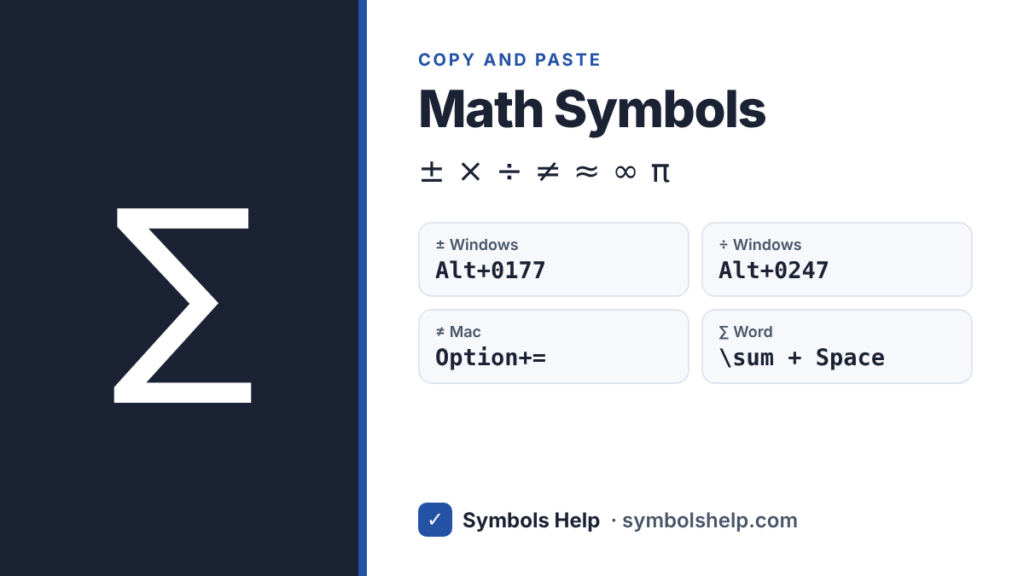
Copy any math symbol with one click below, from ± × ÷ ≠ to √ ∞ π ∑ and ∫. Further down, every symbol is listed with its name, what it means and a short example, grouped by topic.
Summation (sigma)U+2211
Common math symbols · Click any symbol to copy it.
Basic math symbols
| Symbol | Name | Meaning |
|---|---|---|
| + | Plus sign | Addition: 2 + 3 = 5 |
| − | Minus sign | Subtraction: 5 − 2 = 3 |
| × | Multiplication sign | Times: 4 × 3 = 12 |
| ÷ | Division sign | Divided by: 12 ÷ 4 = 3 |
| ⋅ | Dot operator | Also times, common in algebra: 3 ⋅ 4 = 12 |
| = | Equals sign | Same value: 2 + 2 = 4 |
| ± | Plus-minus | Plus or minus: x = ±2 means 2 or −2 |
| % | Percent | Per hundred: 50% = 0.5 |
| ‰ | Per mille | Per thousand: 5‰ = 0.005 |
The true minus sign − is a little longer than the hyphen – on your keyboard and lines up with the plus sign. Use it when the text should look like printed math.
Comparison symbols
| Symbol | Name | Meaning |
|---|---|---|
| ≠ | Not equal to | 3 ≠ 4 |
| ≈ | Almost equal to | Close but not exact: π ≈ 3.14 |
| ≡ | Identical to | Always equal, or congruent in modular math: 7 ≡ 2 (mod 5) |
| < > | Less than, greater than | 2 < 5 and 5 > 2 |
| ≤ ≥ | Less / greater than or equal to | x ≥ 18 means 18 or more |
| ≪ ≫ | Much less / much greater than | 0.001 ≪ 1000 |
| ∝ | Proportional to | y ∝ x means y grows at the same rate as x |
Algebra and number symbols
| Symbol | Name | Meaning |
|---|---|---|
| √ | Square root | √9 = 3 |
| ∛ | Cube root | ∛27 = 3 |
| ² ³ | Squared, cubed | 3² = 9 and 2³ = 8 |
| ∞ | Infinity | Without end: x → ∞ |
| π | Pi | Circle ratio: π ≈ 3.14159 |
| ∑ | Summation | Add a series: ∑ of 1, 2 and 3 = 6 |
| ∏ | Product | Multiply a series: ∏ of 1, 2 and 3 = 6 |
| ½ | One half | ½ = 0.5 |
Geometry symbols
| Symbol | Name | Meaning |
|---|---|---|
| ° | Degree | A right angle is 90° |
| ∠ | Angle | ∠ABC is the angle at point B |
| △ | Triangle | △ABC is the triangle with corners A, B and C |
| ⊥ | Perpendicular | AB ⊥ CD means the lines meet at 90° |
| ∥ | Parallel | AB ∥ CD means the lines never meet |
| ≅ | Congruent | △ABC ≅ △DEF means same shape and size |
| ∼ | Similar | △ABC ∼ △DEF means same shape, maybe a different size |
| ′ ″ | Prime, double prime | Feet and inches: 5′ 10″ |
Set symbols
| Symbol | Name | Meaning |
|---|---|---|
| ∈ | Element of | 3 ∈ ℕ means 3 is a natural number |
| ∉ | Not an element of | ½ ∉ ℤ means one half is not an integer |
| ⊂ ⊆ | Subset of | A ⊆ B means every item of A is also in B |
| ∪ | Union | A ∪ B is everything in A or B |
| ∩ | Intersection | A ∩ B is what A and B share |
| ∅ | Empty set | A set with nothing in it |
| ℕ ℤ ℚ ℝ ℂ | Number sets | Natural, integer, rational, real and complex numbers |
Logic symbols
| Symbol | Name | Meaning |
|---|---|---|
| ∀ | For all | ∀x means “for every x” |
| ∃ | There exists | ∃x means “there is at least one x” |
| ¬ | Not | ¬p means “p is false” |
| ∧ ∨ | And, or | p ∧ q is true when both are true, p ∨ q when at least one is |
| ⇒ | Implies | p ⇒ q means “if p, then q” |
| ⇔ | If and only if | p ⇔ q means both imply each other |
| ∴ ∵ | Therefore, because | Used in proofs: ∴ x = 4 |
Calculus symbols
| Symbol | Name | Meaning |
|---|---|---|
| ∫ | Integral | Area under a curve: ∫ x dx |
| ∂ | Partial derivative | ∂f/∂x is how f changes with x alone |
| ∇ | Nabla (del) | ∇f is the gradient of f |
| Δ | Delta | Change in: Δt is change in time |
| ′ | Prime | f′(x) is the derivative of f |
How to type math symbols
Windows Alt codes
A few math symbols have Alt codes. Hold Alt and type the number on the number pad: ± is Alt + 0177, × is Alt + 0215, ÷ is Alt + 0247, √ is Alt + 251, ∞ is Alt + 236, ≈ is Alt + 247, ≤ is Alt + 243 and ≥ is Alt + 242. Alt + 228 gives Σ, the Greek letter, which looks like the sum sign ∑. See all of them in our Alt Code Finder.
Microsoft Word: type the name
Press Alt + = to start an equation and type a backslash name, then press Space. For example \pm gives ±, \neq gives ≠, \le gives ≤, \infty gives ∞, \sum gives ∑ and \int gives ∫. The same names work in LaTeX.
Tip: these names can work in normal text too. Go to File > Options > Proofing > AutoCorrect Options, open the Math AutoCorrect tab and tick “Use Math AutoCorrect rules outside of math regions”.
Mac
| Symbol | Mac shortcut |
|---|---|
| ≠ | Option + = |
| ≈ | Option + X |
| ≤ ≥ | Option + , and Option + . |
| ± | Option + Shift + = |
| ÷ | Option + / |
| √ | Option + V |
| ∞ | Option + 5 |
| π | Option + P |
| ∑ | Option + W |
| ∫ | Option + B |
| ∂ | Option + D |
| ° | Option + Shift + 8 |
Google Docs
Go to Insert > Equation, then type a backslash name like \pi or \infty and press Space. For a single symbol in normal text, use Insert > Special characters and search by name.
Frequently asked questions
Are these real math symbols or look-alikes?
They are the real Unicode math characters, the same ones used by Word, LaTeX and math websites. For example − here is the true minus sign (U+2212), not a hyphen.
What is the difference between ∑ and Σ?
∑ (U+2211) is the summation sign used in math. Σ (U+03A3) is the Greek capital letter sigma. They look almost the same, but screen readers and search engines treat them differently, so use ∑ for sums.
Which symbol means “therefore”?
∴ means therefore and ∵ means because. Both are in the tool above, under logic.
Can I paste math symbols into Excel or Google Sheets?
Yes, as text. Excel will not calculate with them, though. For real math in a formula use the keyboard signs, like * for times and / for divide.
Sources: the Unicode Mathematical Operators chart and Microsoft Word’s Math AutoCorrect list. Written by Muhammad Ilyas, updated October 2026.
About this page
- Written and checked by: Muhammad Ilyas
- Last updated: October 12, 2026
- Source: Unicode code chart: Mathematical Operators (U+2211)