

Greater-than or equal toU+2265
Greater than or equal to and related signs · Click any symbol to copy it.
Click the big symbol above to copy it. The greater than or equal to sign is ≥ (U+2265). It means “is greater than or equal to”, or simply “at least”. Every symbol on this page is Unicode text, so it pastes into Word, Google Docs, Excel, emails and chats.
Greater than or equal to and related signs
| Symbol | Name | Unicode | HTML code | Alt code (Windows) |
|---|---|---|---|---|
| ≥ | Greater-than or equal to | U+2265 | ≥ | Alt+242 |
| ≤ | Less-than or equal to | U+2264 | ≤ | Alt+243 |
| > | Greater-than sign | U+003E | > | Shift+. on the keyboard |
| < | Less-than sign | U+003C | < | Shift+, on the keyboard |
| ⩾ | Greater-than or slanted equal to | U+2A7E | ⩾ | None |
| ≧ | Greater-than over equal to | U+2267 | ≧ | None |
| ≱ | Neither greater-than nor equal to | U+2271 | ≱ | None |
| ≫ | Much greater-than | U+226B | ≫ | None |
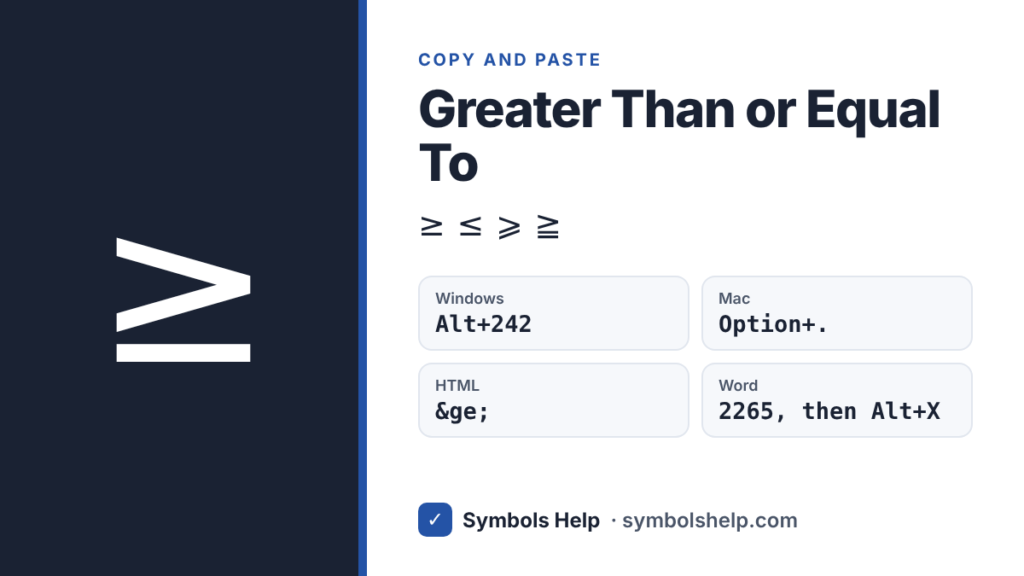
Hold Alt and type the number on the number pad, not the top row of keys.
What does ≥ mean?
a ≥ b means “a is greater than or equal to b”. In plain words, a is at least b.
- age ≥ 18 means 18 or older.
- x ≥ 5 means x can be 5, 6, 7.5, or any bigger number.
- score ≥ 50% means 50% counts as a pass.
The difference from > is the equal part. x > 5 does not include 5, but x ≥ 5 does. On a number line, ≥ is drawn with a filled (closed) dot, and > with an open dot.
Easy way to remember: the wide, open side of the sign always faces the bigger number. The line underneath means “or equal”.
≥ vs ⩾ vs ≧
All three mean the same thing. ≥ is the standard form used in most of the world. ⩾, with a slanted line, appears in some textbooks, especially outside the US. ≧, with two lines, is common in Japanese text. If you are not sure, use ≥.
How to type ≥
On Windows
- Hold Alt and type 242 on the number pad to get ≥.
- Alt+243 gives the opposite sign, ≤.
In Microsoft Word
- Type 2265 and press Alt+X right after it.
- Or go to Insert → Symbol → More Symbols, choose the Mathematical Operators subset, and pick ≥.
- In an equation box (Alt+=), type \geq and press Space.
In Excel
- In formulas, type the two characters >=, like
=IF(A1>=50,"Pass","Fail"). Excel formulas do not understand the ≥ symbol. - To show ≥ in a cell, use
=UNICHAR(8805)or press Alt+242.
In Google Docs
- Go to Insert → Special characters and search “greater”.
- Docs may also turn >= into ≥ as you type. You can check this under Tools → Preferences → Substitutions.
On Mac
- Press Option+. (period) to type ≥.
- Press Option+, (comma) to type ≤.
On iPhone and Android
- Copy ≥ once from this page and save it as a text shortcut, for example “ge” → ≥.
- iPhone: Settings → General → Keyboard → Text Replacement.
- Android (Gboard): Gboard settings → Dictionary → Personal dictionary.
In HTML, LaTeX and code
- HTML:
≥or≥ - LaTeX:
\geq(or\ge). For the slanted form ⩾, use\geqslantwith the amssymb package. - Programming (Python, JavaScript, SQL and others): write
>=. Code uses two characters, not the ≥ symbol.
Frequently asked questions
What is the Alt code for greater than or equal to?
Hold Alt and type 242 on the number pad to get ≥. For less than or equal to (≤), use Alt+243.
How do I type ≥ on a Mac?
Press Option and the period key (Option+.). For ≤, press Option and the comma key.
What is the difference between > and ≥?
means strictly greater, so the number itself is not included. ≥ means greater or equal, so the number is included. For example, x > 3 does not allow 3, but x ≥ 3 does.
Why does Excel not accept ≥ in a formula?
Excel formulas only understand the two-character operator >=. Use >= inside formulas, and use the ≥ symbol only when you want to display it as text.
How do you say ≥ out loud?
Say “greater than or equal to”. In everyday speech, “at least” means the same thing.
Need more math signs? Browse all symbols or search 246 symbols in the Symbol Finder.
Written by Muhammad Ilyas. Every code on this page is checked against the Unicode Standard. Found a mistake? Email hellomyaisteps@gmail.com.
About this page
- Written and checked by: Muhammad Ilyas
- Last updated: October 11, 2026
- Source: Unicode code chart: Mathematical Operators (U+2265)